
Deoxyribonucleic acid, or DNA, is the genetic material of all living things except viruses, which may have either DNA or RNA as their genetic material. DNA passes genetic information to offspring through DNA replication. Genome studies of various organisms show that the information stored in DNA includes regions that are translated into proteins (coding regions) and regions that cannot be translated (non-coding regions). This does not mean the non-coding parts are useless: they can be applied to establish specificity, such as in DNA fingerprinting, and to determine evolutionary relationships.
The structure of DNA consists of two polymer strands of nucleotides wound into a double helix. Each strand is made of deoxyribose sugar, a phosphate group and bases: adenine (A), thymine (T), cytosine (C) and guanine (G). These bases are the genetic code, which can be passed to offspring and translated into proteins used in the cell's activities. A stretch of DNA that can be made into a protein is called a gene; humans have about 34,000–40,000 genes. The double-stranded DNA coils around histone proteins to protect the information from damage and is small enough to be packed into the nucleus. When a cell divides, it appears as structures called chromosomes, as shown in Figure 1.

DNA passes genetic information to the next generation
DNA passes genetic information to newly dividing cells by replicating itself. The chromosomes are seen as rod-like shapes; at that point the chromosomes replicate, increasing from 1 set to 2 sets, and the cell then divides into 2 new cells, as shown in Figure 2.
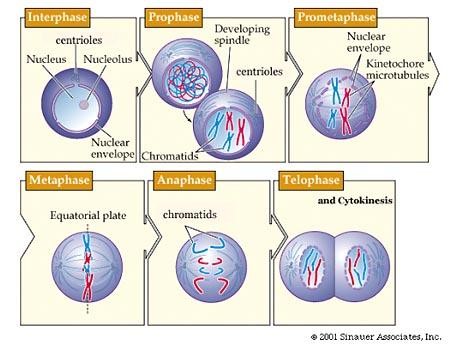
DNA in nature takes many forms: single-stranded and double helix, linear and circular. The details of DNA replication therefore differ, but the general principle is the same, as follows:
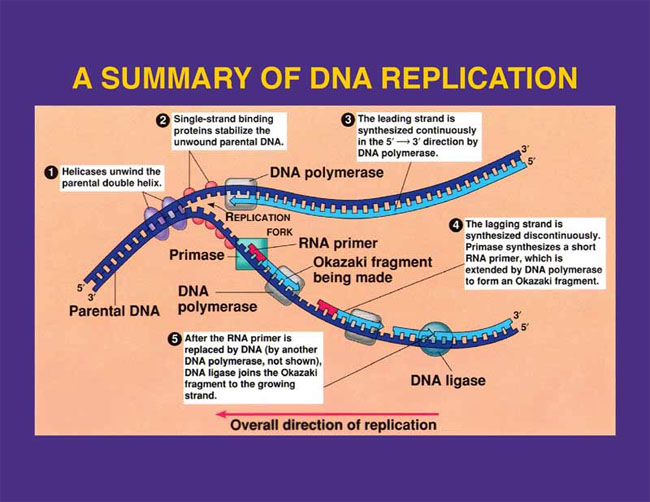
DNA replication (Figure 3) starts at an origin of replication. The double helix unwinds and separates into single strands. RNA primers then attach to both separated template strands. The enzyme DNA polymerase then extends the new strand in the 5' to 3' direction, adding nucleotides whose bases pair with the template: A pairs with T and C pairs with G. The two new strands differ: one is synthesized continuously to the end (the leading strand), while the other is made of short pieces called Okazaki fragments (the lagging strand), separated by RNA primers and not continuous. DNA polymerase I therefore removes the RNA primers and fills in nucleotides, and the enzyme ligase joins the pieces into a single strand. When synthesis reaches the end of the DNA, the enzyme telomerase caps the end of the new strand.
With thanks for information from http://www.barascientific.com/article/DNA/dna.php