
Advances in DNA technology now play a growing role in people's daily lives, in medicine, industry and agriculture. In agriculture in particular, DNA fingerprint technology has begun to be used to verify the purity of varieties and to verify hybrid genetics. In addition, government plant-breeding policies that support technology for the private sector, such as commercial breeders in the seed industry, were the starting point for establishing a DNA fingerprint unit. It was to serve as a center that brings DNA technology to support the work of the public and private sectors, strengthening the country's competitiveness in the free-market global trade arena.

The National Center for Genetic Engineering and Biotechnology (BIOTEC) of the National Science and Technology Development Agency (NSTDA) recognized the importance of preparing both technology development and personnel development in DNA technology. BIOTEC collaborated with Kasetsart University to establish the "Plant DNA Fingerprint Unit" at Kasetsart University, Kamphaeng Saen Campus, in 1995 (resolution of the BIOTEC Executive Board meeting no. 1/1995 on 26 April 1995 [B.E. 2538]), for an initial period of 2 years. The objective was to prepare both technical capacity and personnel for using DNA technology to verify the genetic identity of produced seeds and the purity of varieties, in order to open services to the public and private sectors. Under this collaboration, Kasetsart University provided specialized, knowledgeable personnel as well as the university's premises and facilities, while BIOTEC provided the operating budget, essential scientific equipment and staff salaries. In fiscal year 1998 (B.E. 2541), the BIOTEC Executive Board, at meeting no. 1/1998 on 5 February 1998, approved support for phase 2 of the unit for a further 2 years and renamed it the "DNA Fingerprint Unit", with a main focus on services, an expanded scope beyond plants, and research and development to support services. The unit was to increase its service capability until it could manage and operate independently.
The unit's services had to consider efficiency, low cost, and building networks in marketing and public relations. The DNA Fingerprint Unit Management Sub-committee set direction and oversaw the unit's structure, administration and operations, recommended directions for suitable services and research, and monitored and evaluated the unit's progress. The outcome of Sub-committee meeting no. 2/1999 on 23 July 1999 summarized the approach of giving priority to the unit's future service work, concluding that the unit had the opportunity and feasibility to be managed on a business basis. It therefore proposed preparing for development into a business operation, under the conditions of a special project or NSTDA seed capital, with clear revenue targets, supervised by the NSTDA Investment Center.
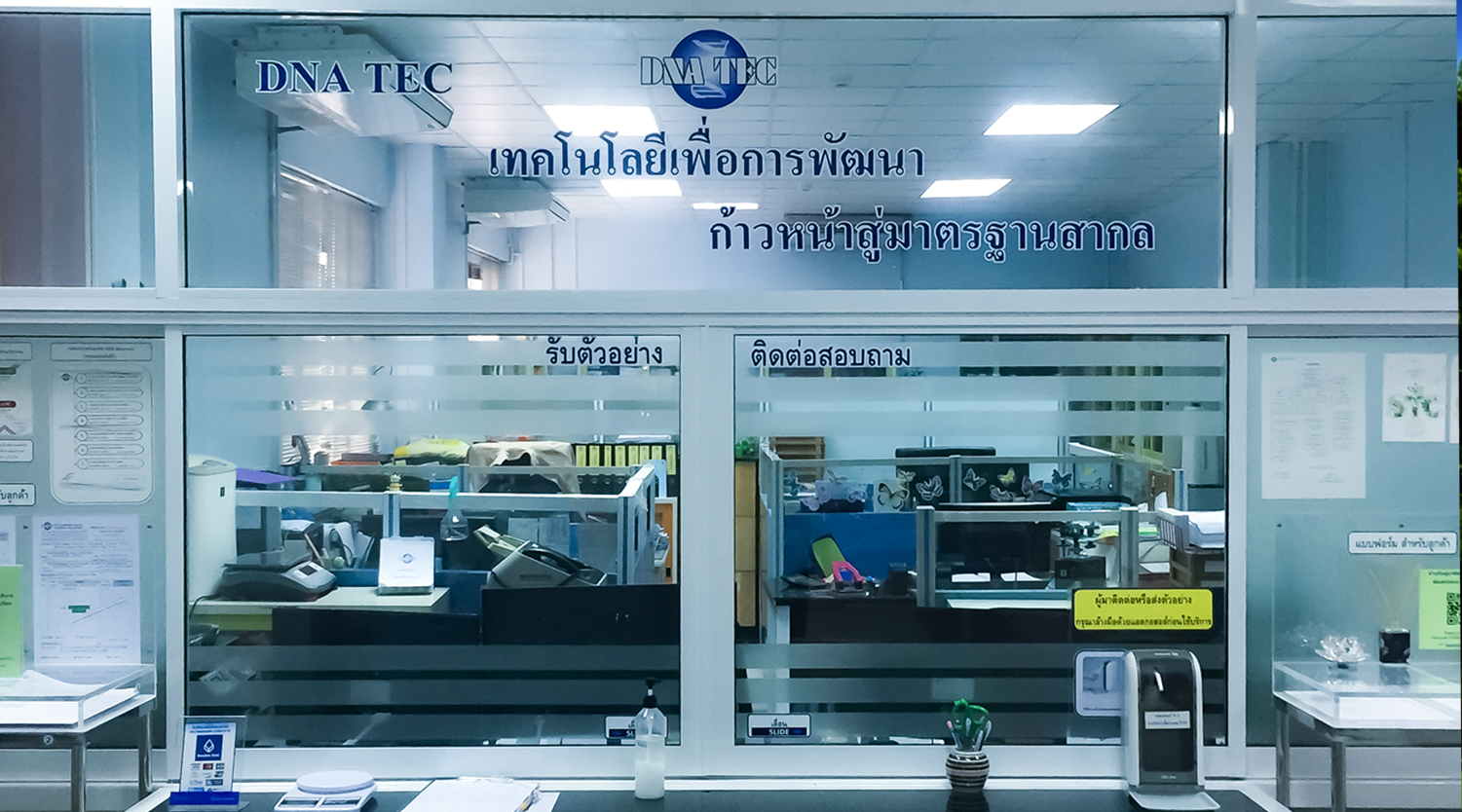
In 1999, by resolution of the NSTDA Board meeting no. 5/1999 on 11 August 1999, NSTDA approved seed capital of 28,174,222 baht to invest in the special project "DNA Fingerprint Unit" together with Kasetsart University for 5 years, from fiscal year 2000 to 2004, with NSTDA contributing 80% and the university 20%. Later, world trade faced protectionism, and many countries turned to non-tariff barriers (NTBs). Genetically modified organisms (GMOs) became widely discussed as a way to improve plants and animals, while the impact of using GM crops remained debated in terms of biosafety. Accordingly, at meeting no. 2/2000 on 23 February 2000, the Board approved an additional 35,846,010 baht of seed capital for the unit to develop a dedicated GMO testing laboratory, and renamed it the "DNA Technology Laboratory" (DNA TEC) to provide DNA technology and GMO testing services. Total NSTDA support came to 64,020,232 baht. At meeting no. 6/2005 on 28 September 2005, the Board approved a 3-year extension, fiscal years 2005 to 2007, for DNATEC to prepare a business model for turning the project into a company or another suitable form; and at meeting no. 8/2007 on 24 September 2007, it approved a further 2-year extension, fiscal years 2008 to 2009, to convert it into a company focusing on private-sector services, namely genetic material diagnosis and GMO testing.
The establishment of special projects within NSTDA to develop commercial benefits falls within the objectives set out in Section 11 (3), (4) and (6) of the Science and Technology Development Act B.E. 2534 (1991), namely: carrying out research, development and engineering work, and supporting government, private-sector and educational research, development and engineering, and promoting cooperation in these activities among government, private sector, educational institutions and other countries, to develop commercial benefits; carrying out and supporting testing and quality analysis services, standard and equipment calibration, information services and technology consulting, and supporting other science and technology services; and promoting the development of the country's science and technology infrastructure, including the development of science and technology manpower in both the public and private sectors.
In terms of administration, DNATEC is a special project using NSTDA seed capital, so its operations follow the "NSTDA Regulation on the Administration of Special Projects Using NSTDA Seed Capital, B.E. 2545 (2002)". NSTDA appointed Dr. Somwong Trakulrung as Director of the special project laboratory, responsible for managing and operating DNATEC in line with its objectives and targets. Oversight and monitoring of DNATEC's performance use the mechanism of the Special Project Laboratory Executive Committee, which sets policy and direction and monitors and evaluates DNATEC's management, with terms of 2 years each and the BIOTEC Director as chair of the committee.